
NiNi’s BIOGRAPHY

Creation : Decay : New Beginnings : Destruction : Re-Creation
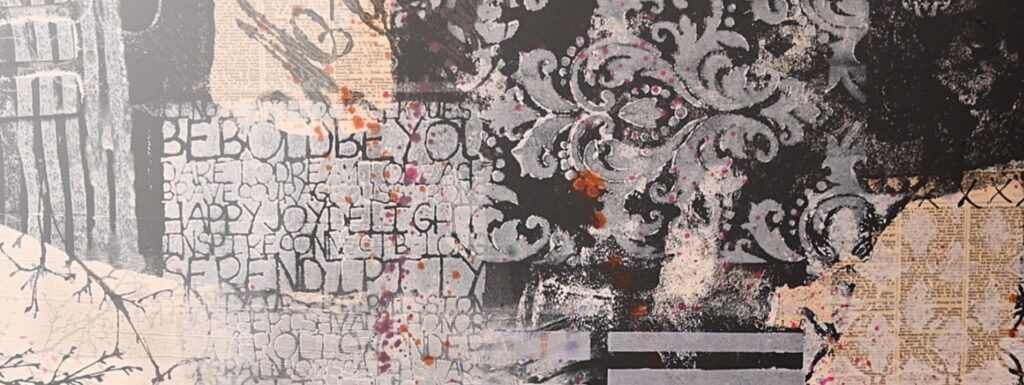
For NiNi, this process symbolically reflects the cycle of life. In her artistic work, NiNi – Nicole Schraner combines painting with drawing, collage and printmaking techniques. Alongside acrylic paint, she also works with tar, wax, rust, stone powders and found, carelessly discarded objects, bringing them together to create emotionally charged stories.
Graphic elements play an important role in her work, whether diagrams, technical drawings, sequences of numbers, printed letters or impressions of shapes and objects. Layer by layer, all these elements are transformed into new contexts and meanings, painted over and, in some cases, scraped away again.
In her painting courses, NiNi combines her professional training with more than 30 years of experience as an adult educator and an artist.
Education & Awards
Artistic Education
- Mosaic studies at the Università di Belle Arti in Ravenna, Italy
- Art studies at the Hochschule für Kunst und Gestaltung (HKG) in Basel
- Further training at art academies throughout Europe
- Founder and owner of DIDAKTIS Adult Education & Coaching and Kunst.Werk.Statt in Basel
- Lecturer and coach for executives and vocational trainers
Methodological and Didactic Education
- University of Zurich: CAS in Adult Education
- Lucerne University of Teacher Education: eLearning Designer
Award
- 2015 Award of Excellence – Rassegna Internazionale d’Arte Contemporanea, Italy
- 2023 Certificate of Appreciation – Lebanese American University
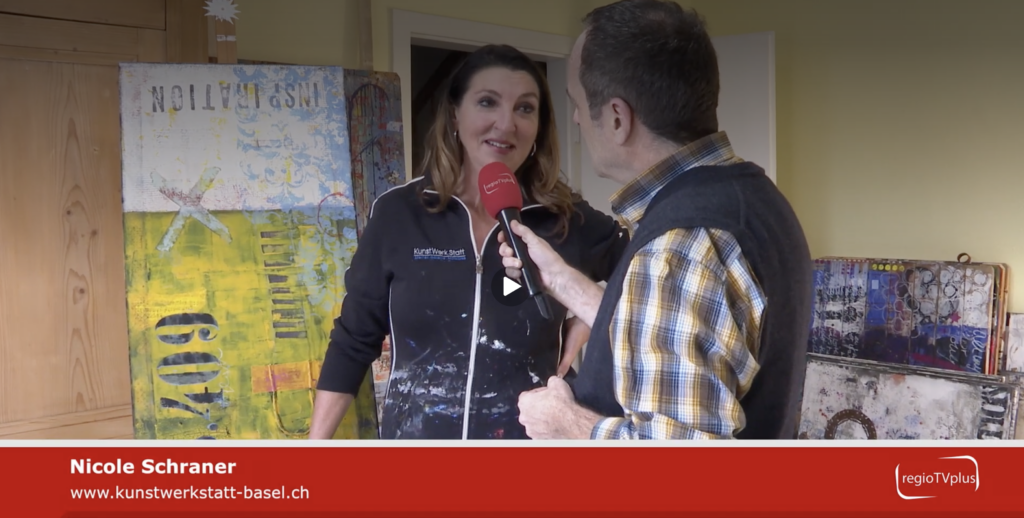
An Art Historian on NiNi’s Work
NiNi’s works are a feast for the senses: rich in texture, materiality, layers and a multifaceted expressive power bursting with joy. She incorporates found objects of many different materials, carelessly discarded by others, into works on canvas or wooden panels. In doing so, she creates an emotional connection between the past and the present, giving these objects a new, highly emotional and even sensual future. Perception, language and communication are among NiNi’s passions, and meaningful texts therefore also find their way into her work.
Letters and numbers are enlarged and draw the viewer’s attention. Removed from their original typographic meaning, they are sometimes reduced to purely graphic elements. In this way, viewers are challenged to reflect on and reconsider their own forms of communication: context versus decontextualisation versus established patterns of perception.
Always searching for narrative key elements, NiNi might discover a handwritten love letter at a flea market, a word taken from a newspaper headline, a piece of rusty iron unearthed from a skip, a handwritten shopping list, a torn scrap of fabric, rare photographs of jazz musicians from the 1930s, or images of pop icons and Mickey Mouse.
NiNi seeks out and discovers beauty and deep emotion in ordinary, discarded objects. These objects carry within them their own stories of places, times and people. Taken out of their original context and recomposed, forgotten and unwanted fragments are transformed through a process of re-composition into a new synthesis, opening the imagination to new meanings and associations.
The result is an entire world of adventure, filled with witty, perceptive, thought-provoking and entertaining narratives, a generous gift of beauty and honesty created from fragments once considered worthless.
Each canvas becomes a field of inspiration, combining emotion with expressive power and releasing enormous creative potential. This is particularly evident in NiNi’s commissioned works. She engages deeply with the wishes, needs and emotions of her clients, incorporating them into her paintings, sometimes clearly recognisable to others, sometimes carefully concealed.
With great care and sensitivity, NiNi creates works that, despite their complexity, multiple layers and diversity, retain a sense of classical elegance. They continually reveal new details and relationships to the viewer. The chaotic diversity of life is brought into balance, yet a playful sense often remains, quietly revealing itself to those who look closely. The works never disclose all their secrets at once.
Susanne Blaser, Art Historian